The 2026 Blueprint for Growing a Minecraft Community

By askray. in Official Guides
· 269 views
Growing a server in 2026 isn't just about "being friendly." It’s about building a digital brand that players can access anywhere, on any device, without lag. Whether you’re running a vanilla SMP or a heavy-duty modded Forge world, here is how you turn a lobby of three friends into a thriving community.
1. The Core Strategy: Modernizing the Basics
The "30-Second Hook" (Unique Experience)
In 2026, the first 30 seconds of a player’s session determine if they’ll ever come back.
The Update: Forget the "wall of text" rules at spawn. Use interactive NPCs or a guided starter quest that immediately gives the player a tool or a purpose. If they don't feel "powerful" or "curious" within a minute, they’ll leave.
Community Governance (Active & Friendly)
"Friendly" is a given. Today, players want ownership.
The Update: Integrate your server with DiscordSRV so the community lives in their pockets. Use a "Governance" model where players can vote on new features or economy shifts. When players help build the world's lore, they don't quit, because quitting means losing their history.
The Short-Form Content Funnel (Promotion)
Forums are for archives; TikTok/Reels are for growth.
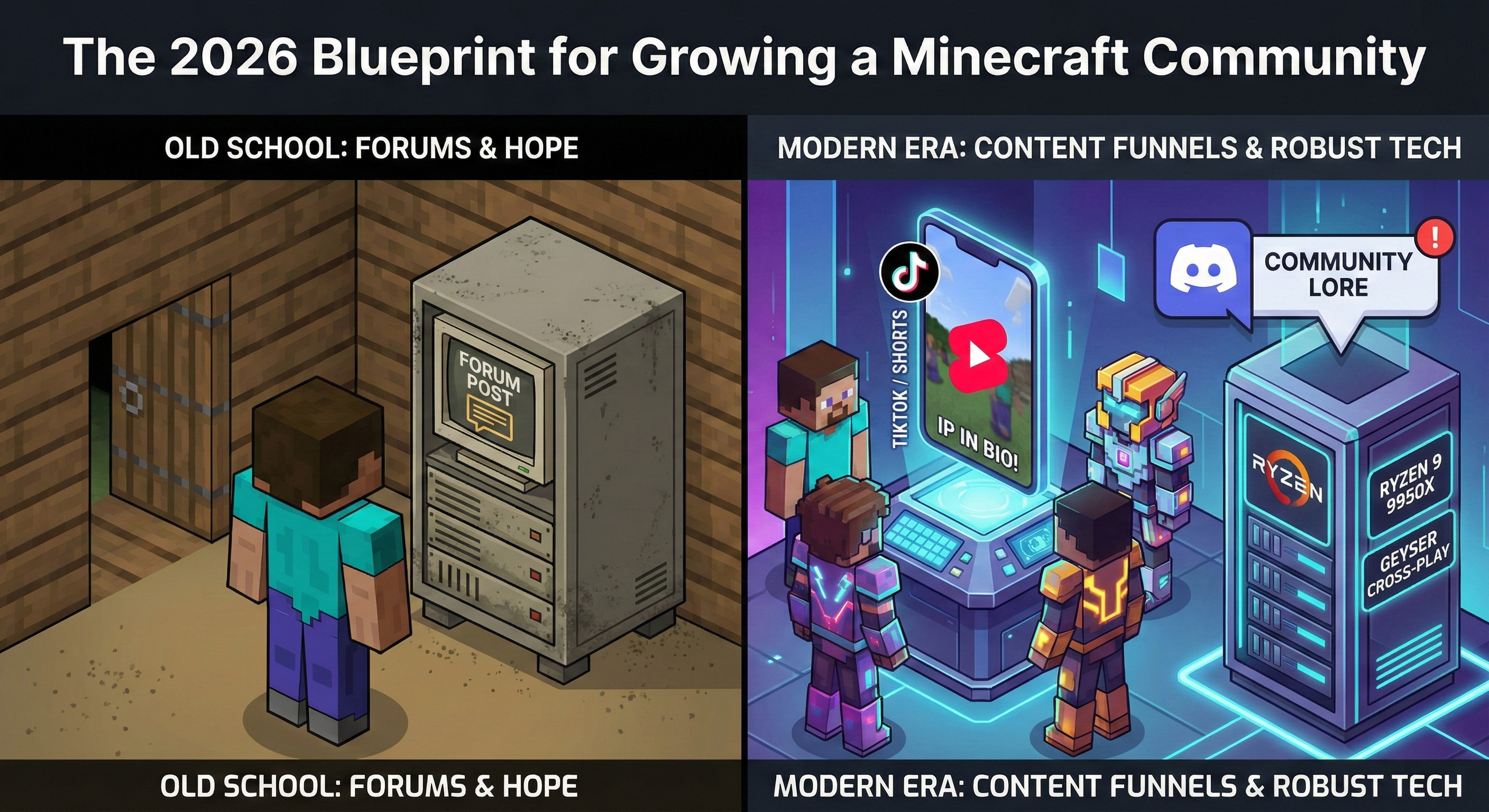
The Update: You are no longer a "Server Owner"; you are a "Content Creator." Record 15-second clips of base tours, "admin abuse" pranks (the harmless kind!), or satisfying build time-lapses. Use the "IP in Bio" strategy to funnel millions of potential viewers directly to your server address.
2. Technical Excellence: Robust Operations
The Hardware Standard
In 2026, "minimal lag" means running at a constant 20 TPS (Ticks Per Second) regardless of how many TNT cannons are firing.
The Spec: Look for hosts using AMD Ryzen 9 9900X or 9950X processors. Minecraft is primarily single-threaded; you need high clock speeds (5.6GHz+), not just "more RAM."
The Storage: Ensure you’re on NVMe Gen4 or Gen5 SSDs. This virtually eliminates "chunk lag" when players are flying with Elytras.
The "Geyser" Requirement (Cross-play)
If your server is Java-only, you are ignoring half the market.
The Update: Use GeyserMC and Floodgate. This allows Bedrock players (Xbox, PlayStation, Mobile) to join your Java server seamlessly. In 2026, accessibility is the #1 growth hack.
3. The Power of Forge: Running Modded Operations
If you’re running a Forge server, you’re playing on "Hard Mode." Modded Minecraft is significantly more resource-intensive, but it offers a level of depth that keeps players around for months instead of weeks.
Managing the "Modded" Load
Forge servers can eat CPU for breakfast. To keep operations robust:
Pre-Generate Everything: Use a plugin like Chunky to pre-generate your world map. Modded world-gen (like Terraforged or Oh The Biomes You'll Go) is a server-killer. If the server has to generate those biomes while 10 people are exploring, it will crash.
The Modpack Barrier: The hardest part of Forge is getting players to download the mods.
Pro-Tip: Create a custom profile on CurseForge or Modrinth and share the "One-Click" link in your Discord. The easier it is to join, the more players you'll get.
Optimization for Forge
Standard "lag fix" plugins usually break Forge mechanics. Instead:
Use Spark to profile your server performance. It will tell you exactly which modded machine or entity is eating your TPS.
Allocate at least 8GB–12GB of RAM if you have 100+ mods, but don't over-allocate (it makes Java's "Garbage Collection" slow down the server).
4. Automation: The "Always On" Server
You can't be online 24/7, but your server should feel like you are.
Automated Events: Set up a plugin like EliteCreatures or SpecialEvents to trigger a boss fight or a "supply drop" every 6 hours automatically.
Self-Service Ranks: Use LuckPerms with a web store (like Tebex) so players can earn or buy ranks/perks instantly without needing an admin to manually type commands.
The 2026 Reality Check: Growth is about retention. It’s easier to keep one player for a year than to find 365 players for one day. Focus on the vibe of the first five minutes and the smoothness of the hardware.
Recommended Comments